 how-to
How to Manage Food Production Inventory Planning
Last Updated: October 25, 2026
Quick Summary
Food production inventory planning is the process of forecasting, tracking, and managing raw materials and finished goods to meet production schedules without overstock or shortages. It connects demand forecasting to purchasing, production, and storage decisions to prevent waste and stockouts.
- Calculate reorder points using the formula: average daily usage multiplied by lead time in days, plus safety stock of 10-30%.
- Implement FIFO and FEFO stock rotation methods to ensure older inventory and items nearing expiration are used first.
- Track inventory accuracy, stockout frequency, turnover rate, and waste percentage monthly to identify improvement opportunities.
- Use inventory management software with lot tracking, expiration alerts, barcode scanning, and real-time visibility across storage locations.
- Review expiration dates weekly and adjust forecasts based on actual shelf life to minimize disposal and spoilage.
Table of Contents
- Understanding Food Production Inventory Planning Fundamentals
- Step 1: Establish On-Hand Stock Visibility and Counting Procedures
- Step 2: Implement Food Production Demand Forecasting Methods
- Step 3: Calculate Reorder Points and Safety Stock Levels
- Step 4: Apply FIFO and FEFO Inventory Management Practices
- Step 5: Monitor Expiration Dates and Shelf-Life Management
- Step 6: Use Food Inventory Management Software and Automation
- Step 7: Apply Food Inventory Management Best Practices for Continuous Improvement
- Frequently Asked Questions
Understanding Food Production Inventory Planning Fundamentals
Food production inventory planning is the process of forecasting, tracking, and managing raw materials and finished goods to meet production schedules without overstock or shortages. It connects demand forecasting to purchasing, production, and storage decisions.
Why does this matter? A broken inventory system wastes money. You either tie up cash in excess stock that spoils, or you run short and miss production deadlines. The goal is balance: having what you need, when you need it, without waste.
For food businesses, inventory planning is harder than most industries. Perishable goods have shelf lives. Ingredients expire. Demand fluctuates seasonally. Raw materials arrive on different schedules than finished products ship. One miscalculation cascades through your entire operation.
This guide covers seven practical steps to build a food production inventory planning system that actually works. We'll walk through counting procedures, demand forecasting, reorder calculations, stock rotation, expiration tracking, software tools, and continuous improvement methods. Whether you're managing spices, powders, grains, or finished snacks, these principles apply.
Step 1: Establish On-Hand Stock Visibility and Counting Procedures
You cannot plan what you don't see. The first step is knowing exactly what inventory you have right now.
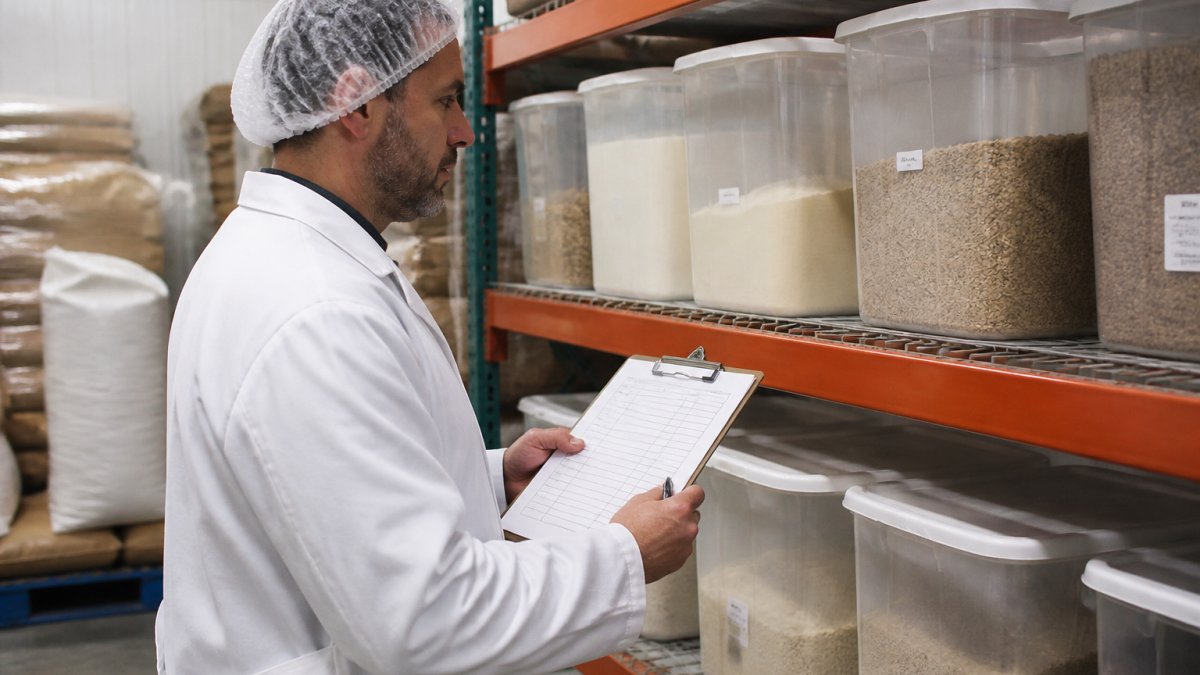
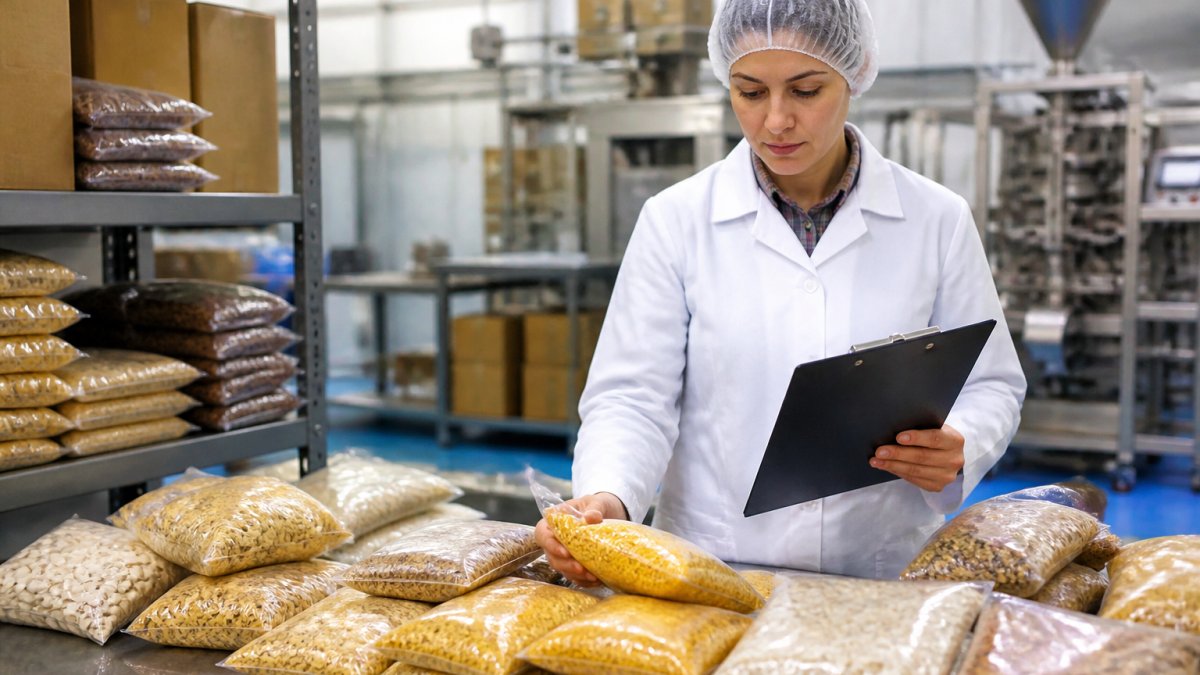
Start with a physical count. Walk through your storage area and document every ingredient, material, and finished good. Record the product name, lot number, quantity, location, and date counted. This becomes your baseline.
Then establish a counting rhythm. Many businesses count critical items weekly and slower-moving inventory monthly.
Use clear labels and organized storage. Group similar items together. Label shelves with product names and lot numbers. This speeds up counting and reduces errors.
Document your counts consistently. Use the same form every time. Include:
- Product name and SKU
- Lot number and date received
- Quantity on hand
- Location in storage
- Count date and person who counted
- Any discrepancies or damaged goods
Accuracy matters more than speed. A slow count that's correct beats a fast count with errors.
Most businesses find that establishing counting procedures reduces inventory shrinkage by catching damaged goods, expired stock, and misplaced items early.
Step 2: Implement Food Production Demand Forecasting Methods
Demand forecasting predicts how much product you'll need to produce in the coming weeks or months.
Start simple. Look at your sales history for the last 12-24 months. How much did you sell in January, February, March? What was the trend?
Then ask: what's different this year? Are you launching a new product? Entering a new market? Have customers changed their ordering patterns?
Use these forecasting methods:
- Seasonal analysis: If you sell 20% more product in summer than winter, build that into your forecast. Track which months are busy and which are slow.
- Growth trend: If you grew 15% year-over-year, apply a similar growth rate to your forecast. But be conservative: not all growth continues.
- Customer commitments: If a major customer told you they're increasing orders by 30% next quarter, factor that in. Don't guess, ask your customers what they plan to buy.
- Market events: Trade shows, promotional campaigns, and new product launches drive demand spikes. Plan for them.
Document your forecast assumptions. Write down why you chose specific numbers. This helps you adjust when reality differs from your prediction.
Review and update your forecast monthly. Real sales data replaces old estimates. As the month progresses, you learn whether your forecast was accurate.
These forecasting methods help predict production needs based on sales patterns and business changes.
| Forecasting Method | What It Does | Best For |
|---|---|---|
| Seasonal analysis | Identifies months with higher or lower demand | Products with predictable seasonal spikes |
| Growth trend | Applies year-over-year growth rates to forecasts | Businesses with consistent growth patterns |
| Customer commitments | Incorporates planned order increases from major customers | Accounts with known purchasing plans |
| Market events | Plans for demand spikes from trade shows and campaigns | New product launches and promotions |
Step 3: Calculate Reorder Points and Safety Stock Levels
A reorder point is the inventory level at which you place a new purchase order.
The formula is simple: (average daily usage × lead time in days) + safety stock.
Here's how to use it:
Step 1: Calculate average daily usage. If you use 100 units per day on average, that's your daily usage.
Step 2: Determine lead time. How many days does it take from when you order to when the goods arrive?
Step 3: Multiply them. 100 units/day × 10 days = 1,000 units. You need at least 1,000 units on hand when you order, or you'll run out before the new shipment arrives.
Step 4: Add safety stock. Safety stock is extra inventory you keep to handle unexpected demand spikes or supplier delays.
Using the example above: 1,000 units + (1,000 × 20%) = 1,200 units. Your reorder point is 1,200 units.
Safety stock protects you from two things: demand that's higher than expected, and supplier delays. The more unpredictable your business, the more safety stock you need. The more reliable your suppliers, the less you need.
Calculate reorder points for each major ingredient or finished product. Write them down. When inventory hits that level, order automatically.
Many businesses set reorder points too low. They think they're saving money by ordering less frequently. Then they run short.
Step 4: Apply FIFO and FEFO Inventory Management Practices
FIFO means First In, First Out. It's a stock rotation method that ensures older inventory ships before newer inventory.
Request a Manufacturing Quote →
Here's why it matters: if you receive ingredient A on January 1 and ingredient A again on January 15, you want to use the January 1 batch first.
FEFO means First Expired, First Out. It's similar but based on expiration date instead of arrival date. If two batches of the same ingredient have different expiration dates, use the one expiring sooner first.
Implement FIFO and FEFO with clear labeling and organized storage:
- Label every shipment with the arrival date and expiration date
- Store older stock in front, newer stock in back
- Train staff to always pull from the front
- During production, pull ingredients in order of age or expiration date
Use your inventory records to track which lots are in storage. When you pull inventory for production, document which lot you used.
FIFO and FEFO reduce waste. Older stock doesn't expire sitting in storage. They also simplify recalls: you know exactly which finished products contain which ingredient lots.
Step 5: Monitor Expiration Dates and Shelf-Life Management
Expired inventory is waste. It cannot be sold. It ties up storage space. It creates liability.
Track expiration dates for both raw materials and finished goods. For each item in storage, know:
- The expiration date
- How many days until expiration
- Whether it's approaching the "use by" date
Create an expiration report. List all inventory organized by expiration date, with items expiring soonest at the top. Review this report weekly.
For items approaching expiration, you have options:
- Use them in production if demand allows
- Discount them for quick sale
- Donate them if regulations allow
- Dispose of them if necessary
The goal is to minimize disposal. But some waste is inevitable in food production. Plan for it.
Understand shelf life for your products. How long does a finished good stay fresh after packaging? How long do raw materials last in storage?
FDA guidance on food shelf life and dating
Document shelf-life assumptions for each product. Use that data when forecasting: if a product has a 6-month shelf life, don't forecast 12 months of inventory.
Work with strong quality and traceability systems to maintain lot traceability and production documentation that supports expiration tracking and compliance.
Step 6: Use Food Inventory Management Software and Automation
Manual spreadsheets work for small operations. But as you grow, spreadsheets become error-prone. Data lives in multiple places. Updates happen slowly. Forecasts get outdated.
Inventory management software automates counting, forecasting, and reordering. It tracks lot numbers, expiration dates, and storage locations. It generates reports on stock levels, usage rates, and inventory accuracy.
Key features to look for:
- Real-time inventory visibility across all storage locations
- Lot tracking and expiration date alerts
- Automated reorder point calculations
- Demand forecasting based on historical sales
- Barcode scanning for fast, accurate counting
- Integration with your production and sales systems
- Mobile access so staff can check inventory from the warehouse
Good inventory software reduces counting time, prevents stockouts, cuts waste, and frees up staff time for higher-value work. Explore how one partner offering multiple capabilities, including contract manufacturing, co-packing, custom dry blending, freeze-drying, ingredient sourcing, packaging procurement, and warehousing, can integrate with your inventory automation to simplify your entire supply chain.
When choosing software, consider your current operation size and your growth plans. You want a system that scales with you. You also want training and support: good software is only useful if your team knows how to use it.
Consider working with a partner offering multiple capabilities to explore how integrated manufacturing and warehousing services, combined with inventory automation, simplify your supply chain and reduce inventory complexity.
Step 7: Apply Food Inventory Management Best Practices for Continuous Improvement
Food production inventory planning is not a one-time project. It's an ongoing process. You set it up, then continuously improve it.
Track key metrics:
- Inventory accuracy: How often does your physical count match your records? Target 95%+. If accuracy is lower, investigate why. Are staff not following procedures? Is your software not updating correctly?
- Stockout frequency: How often do you run out of critical ingredients? Track this monthly. If stockouts happen, your reorder points or safety stock levels are too low.
- Inventory turnover: How many times per year do you sell through your entire inventory? Faster turnover means fresher product and less waste. Slower turnover ties up cash and increases expiration risk.
- Waste rate: What percentage of inventory expires or spoils? Track this by product. If waste is high for one item, adjust your forecast or reorder point.
Review these metrics monthly. Look for trends. If inventory accuracy is dropping, retrain your team. If stockouts are increasing, raise safety stock.
Meet with your team regularly. Ask warehouse staff what's working and what's not. They see problems before anyone else.
Use this feedback to adjust your system. Small improvements compound over time.
Consider discussing your inventory optimization goals with Northridge Industries. When you outsource manufacturing and packaging, you reduce inventory complexity, you don't need to hold finished goods inventory.
Managing food production inventory planning prevents stockouts, reduces waste, and improves cash flow. Start by counting what you have. Forecast what you'll need. Calculate when to reorder.
Frequently Asked Questions
What is the difference between FIFO and FEFO in food inventory management?
FIFO (First In, First Out) means the oldest stock moves out first, based on receiving date. FEFO (First Expired, First Out) prioritizes items by expiration date, not arrival order. FEFO is better for perishable and shelf-stable foods with varying shelf lives. Many food manufacturers use FEFO to prevent expired goods from reaching customers and to reduce spoilage waste.
How do you forecast demand for food production?
Review your sales history over the past 12-24 months, identify seasonal patterns and growth trends, and factor in upcoming promotions or new customer orders. Calculate average monthly usage and apply a growth percentage based on your business forecast. Use this to set production quantities and ingredient orders. Adjust forecasts quarterly as actual sales data comes in.
How can food manufacturers reduce ingredient waste?
Track expiration dates closely using FEFO rotation, forecast demand accurately to avoid overproduction, store ingredients at proper temperatures to extend shelf life, and conduct regular inventory audits to catch slow-moving stock early. Consider consolidating suppliers or outsourcing production to a co-packer who can blend and package ingredients efficiently, reducing spoilage and obsolete inventory.
What inventory should food manufacturers track?
Track raw materials (ingredients, packaging, labels), work-in-progress (partially finished batches), and finished goods (packaged products ready for sale). Record receiving dates, expiration dates, batch numbers, storage location, and quantity on hand. Maintain production records linking each batch to its ingredients and manufacturing date. This traceability supports compliance, recalls, and accurate cost accounting.